A NorCal Fly Fishing Meca

Pauley Creek Guide

  Below the dramatic Sierra Buttes, rain, snowmelt, and natural spring come together, and The North Fork Yuba River is born. The upper reaches of this river are strewn with car sized granite boulders and terrain covered with Manazita, Oak, and conifers. Rainbow and Brown trout are eager to feed in the 100s of plunge pools that step their way down the canyon. The North Yuba also attracts anglers from all over the state who make their own journey to ply the waters whether it is by fly or lure. Here is a place than can offer unbound beauty, adventure, solitude, and a chance to hook into a trophy trout!

As you make your up Highway 49 from Nevada City there are numerous major access points along the way upstream after the first bridge crossing near the Canyon Creek trailhead. Other obscure access areas are mere pullouts with steep descents down to the river and only for the most adventurous souls. What sets this river apart from the many grand waters of Northern California is the type of water preferred by fly anglers; pocket water, pools and gin clear water.

The North Yuba is open year all year for fishing but with special regulations. There is a “wild trout” section from Sierra City to Ladies Canyon Creek and only barbless flies and artificial lures may be used with a two fish limit if one decides to keep their catch. Most fly anglers practice “catch and release” fishing so that the populations of wild trout may grow bigger and provide others with the enjoyment of catching the big one. The California Department of Fish and Wildlife’s regulation booklet provides all the information a visiting angler needs to be legal here and should be reviewed before venturing out onto the water.

Winter and spring conditions are rather tough for successful fishing, low water temperatures and high water makes it difficult for even expert anglers. The most productive fishing takes place after spring runoff has ended which normally takes place sometime in May. As summer engulfs the North Yuba so do the aquatic insects that the wild trout eagerly dine on. Hatches of mayflies, caddis, and stoneflies fill the air and offer exciting “dry fly” fishing, presenting flies that float on the surface of the water enticing a trout to rise to the occasion and devour the artificial offering. Great fishing continues through even the hottest dog days of summer as the upper river still provides cold water. Fall is a special time on the North Yuba, leaves glow showing their spectacular colors and the trout feed more aggressively knowing they have to fatten up for the long cold winter months ahead of them. There is also a special aquatic insect that hatches this time of year and even has a cult following amongst fly anglers. The October Caddis is a large specimen with a burnt orange color that brings up some of the largest trout for a floating prime rib dinner drifting down the currents.

There are no special tackle requirements to fish the North Yuba, a 3-5 weight rod matched with a floating line and leaders to 4-6x will perform nicely.  A dry/dropper will land you the highest fish count.  Save the dry only for the late afternoons. Sierra Hardware in Downieville is the only place in the area you can find terminal tackle and a large assortment of the “go to” flies that work best on the river. The store owner has been helping fly fishermen for the last 40 years- she knows what works.

The North Fork Yuba is a fascinating river with a surprise around every corner. This fishing has a shorter season than some of the famous tailwaters.  This is an excellent place for a beginner- the fly choice is not critical and the casts tend to be short.  Just don’t let them see you coming.  There are some larger fish that can be taken by the more seasoned angler.

Most of the fish are small and are not suited for the pan -put em back.

California Mountain Kingsnake

California Mountain Kingsnake

I found this beautiful California Mountain Kingsnake by the North Yuba River.  In spite of the bright colors, this snake is not poisonous.  In the wild, they can live 10 to 15 years.  

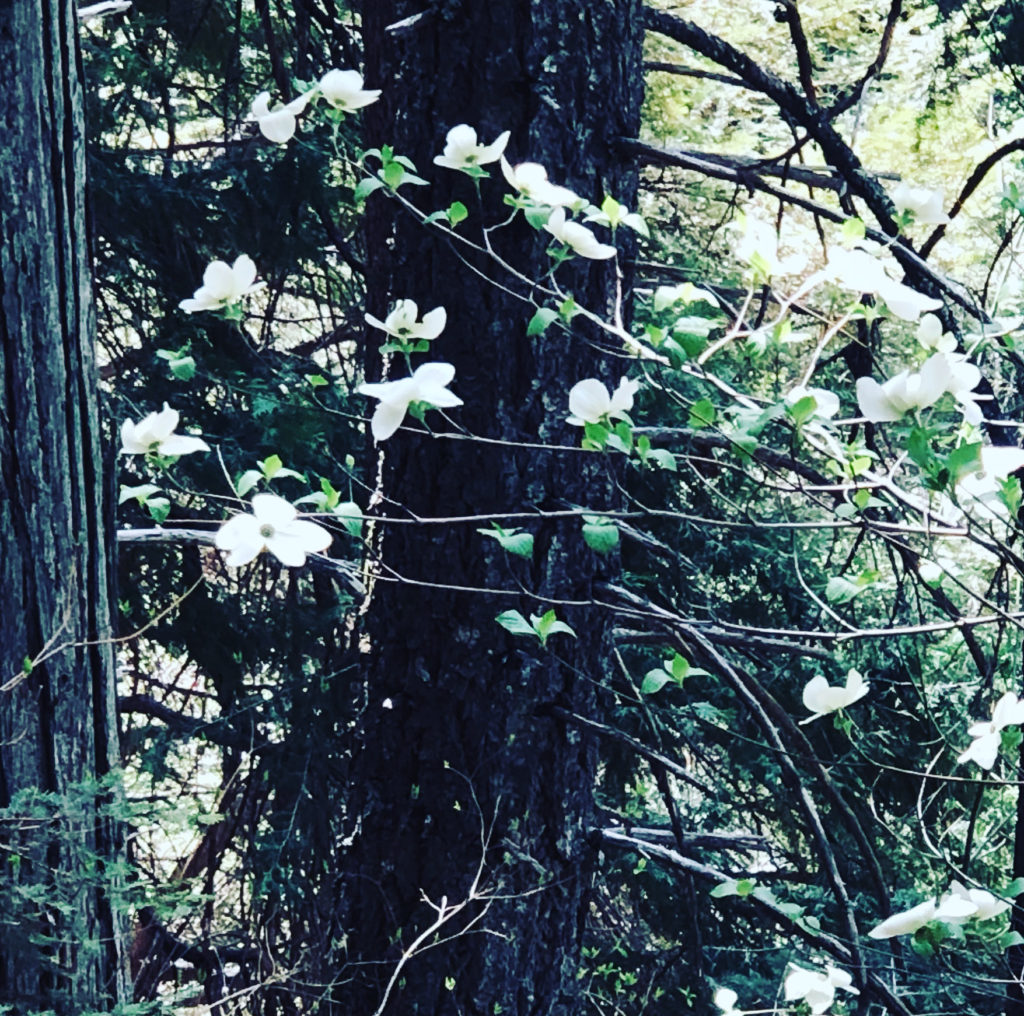
Check out the Pacific Dogwoods

Pacific Dogwood North Yuba Trail

The Pacific Dogwoods are going off right now.  They are a beautiful reminder that Summer is coming.  Get to the mountains this weekend and check them out. 

From the US Forest Service:

‘Pacific dogwood is in the Cornaceae (dogwood Family) which contains approximately 12 genera and 100 species distributed primarily through temperate and tropical mountainous regions. Indigenous people used the bark of Pacific dogwood to make a brown dye and a decoction for stomach trouble. Young shoots were often used for weaving baskets. The wood of this species is hard and heavy and has been used commercially to make a wide variety of products including bows, arrows, thread spindles, cabinets, piano keys, mallet handles, and golf club heads. In medieval times, the hard wood of dogwood species was used for making wooden daggers. The brilliant fall colors of the leaves make Pacific dogwood a valuable ornamental. As with its close relative, flowering dogwood, it is susceptible to dogwood anthracnose, a disease caused by the nonnative fungus Discula destructiva. The disease is responsible for the death of some larger trees in the wild and the disease has restricted its Pacific dogwood’s use as an ornamental.

Pacific dogwood is a deciduous tree growing up to 20 meters tall (66 feet) with a smooth dark bark. Leaves are oval, pointed at the tip, 4-10 cm (1.6-3.9 inches) long, deep green in color, and have parallel veins. Flowers occur in tight clusters 1.5-2 cm (0.6-0.8 inches) wide and are subtended by 4-8 conspicuous white bracts 2-7 cm (0.8-2.8 inches) long. Petals are greenish white and often tinged purple. Trees will flower in the spring and often again in the fall. Fruits are bright red and approximately 10 mm (0.4 inches) long.

Distribution is restricted to the Pacific Northwest and California extending from southern British Columbia south through Washington, Idaho and Oregon to California primarily west of the Cascades and Sierra Nevada. It has a relatively low tolerance to frost, a relatively high tolerance to flooding and is moderately shade tolerant. It is common along stream banks in low elevation coniferous, hardwood, and mixed coastal forests. It prefers moist but well drained soils on gentle slopes predominantly below 1500 meters (5000 feet) elevation. It is capable of sprouting from root crowns after fire.

Deer and elk browse young Pacific dogwood sprouts for forage. Small mammals such as deer mice and the red tree vole and birds, including band-tailed pigeons and pileated woodpeckers feed on the fruits.

Cornus nuttallii was named after Thomas Nuttall, an English botanist and zoologist who worked in the United States during the 1800s’

Pacific Dogwood North Yuba Trail

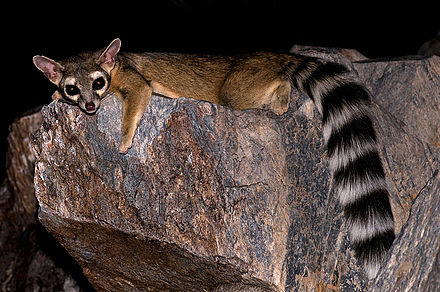
Ring-Tailed Cat visits us

We had a Ring-Tailed Cat come by.  They are rarely seen but are widely distributed.  It’s probably the cutest wild animal that we’ve come across.

From Wiki:

The ringtail is black to dark brown in color with pale underparts. Ringtails have a pointed muzzle with long whiskers resembles that of a fox (its Latin name means ‘clever little fox’) and its body that resembles that of a cat. The ringtailed’s face resembles a mask as dark brown and black hair surround its eyes.[2] These animals are characterized by a long black and white “ringed” tail with 14–16 stripes,[3] which is the about the same length as its body. The claws are short, straight, and semi-retractable, well-suited for climbing.[4]

Smaller than a house cat, it is one of the smallest extant procyonids (only the smallest in the olingo species group average smaller). Its body alone measures 30–42 cm (12–17 in) and its tail averages 31–44 cm (12–17 in) from its base. It typically weighs around 0.7 to 1.5 kg (1.5 to 3.3 lb).[5] Its dental formula is 3.1.4.23.1.4.2 = 40.[6]

Ringtails are primarily nocturnal, with large eyes and upright ears that make it easier for them to navigate and forage in the dark. An adept climber, it uses its long tail for balance. The rings on its tail can also act as a distraction for predators. The white rings act as a target, so when the tail rather than the body is caught, the ringtail has a greater chance of escaping.[7]

Ringtails have occasionally been hunted for their pelts, but the fur is not especially valuable. Fur trapping has slowed down considerably, but current population sizes and growth rates remain unclear.[8]