
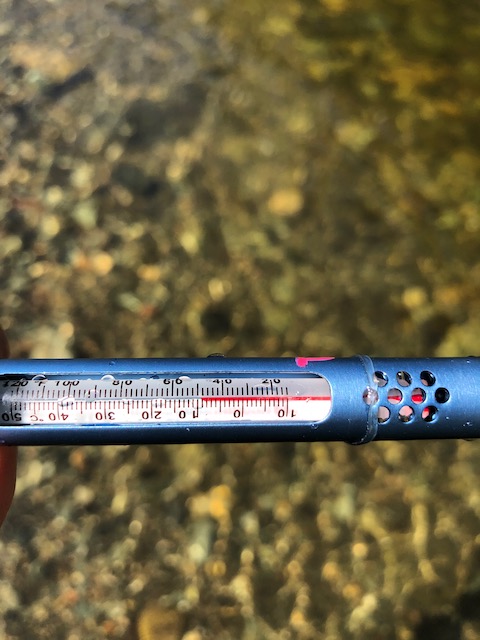
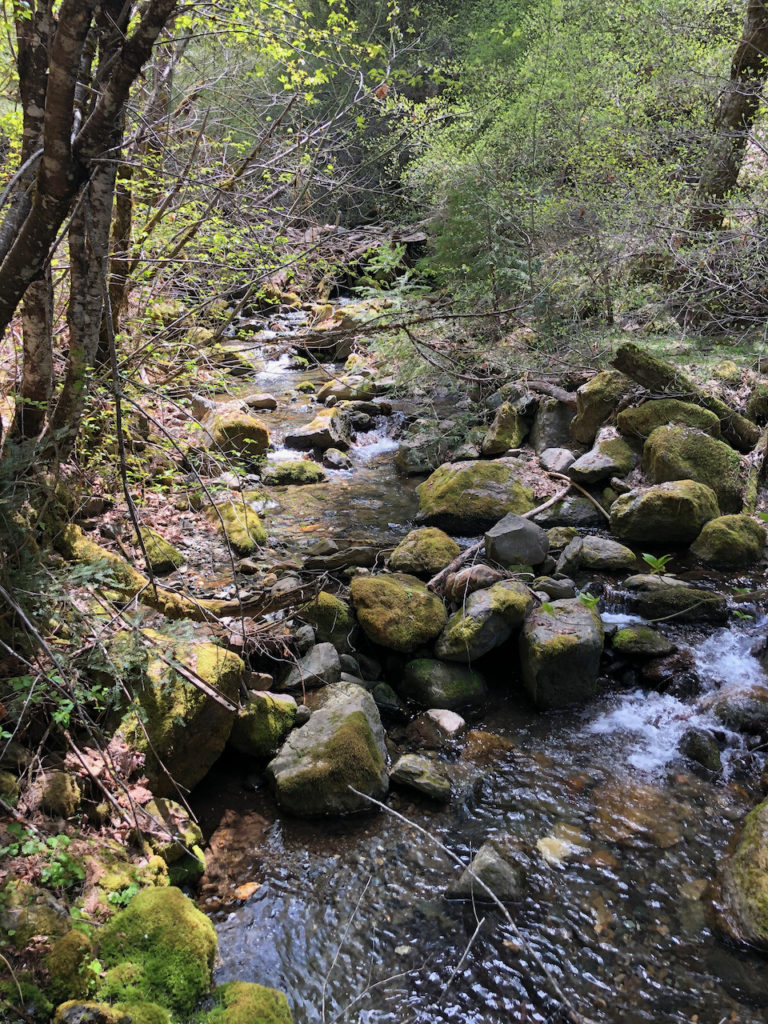
On Saturday morning the water temperature was 49 degrees and the flow was 900 cubic feet per second. These numbers are not good. You can catch fish but your numbers will be low. The lovely weather is speeding up the snowmelt. The quick snowmelt is raising the river and lowering the water temperature. Bring your bike, hiking boots, camera…bring your fly rod too but don’t expect to catch what you would in June…

Here are a few tips that will keep you in the game and be more successful while playing the creeks fly fishing game:
1)These creeks are primarily dry fly action. It’s heaven. Keep your fly high and dry. Start with floatant. If it starts to sink, use some desiccant to extend it. If it gets saturated, change it to a new one. Add a dropper to go after the larger fish in the darker water.
2) In these creeks, you need to be quick on the hook set. Don’t over do it! Just quick. Think 1 o’clock to 11 o’clock
3) Get your short cast dialed in. You’ll want to work each section with precision. Get the fly just ahead of the where the fish are, don’t ‘line’ them with your fly line
4) The terrain is rough. Bring a wading staff to help getting up and down the steep slopes and when navigating the rocks and boulders. You’ll want to get into the water to get a clear back cast, a wading staff will keep you much more stable in the fast water.
5) If you can, hike in from the access point. Most people tend to fish pretty close to the car. Even if you are short on time, invest in some distance and reward yourself with more fish and solitude.

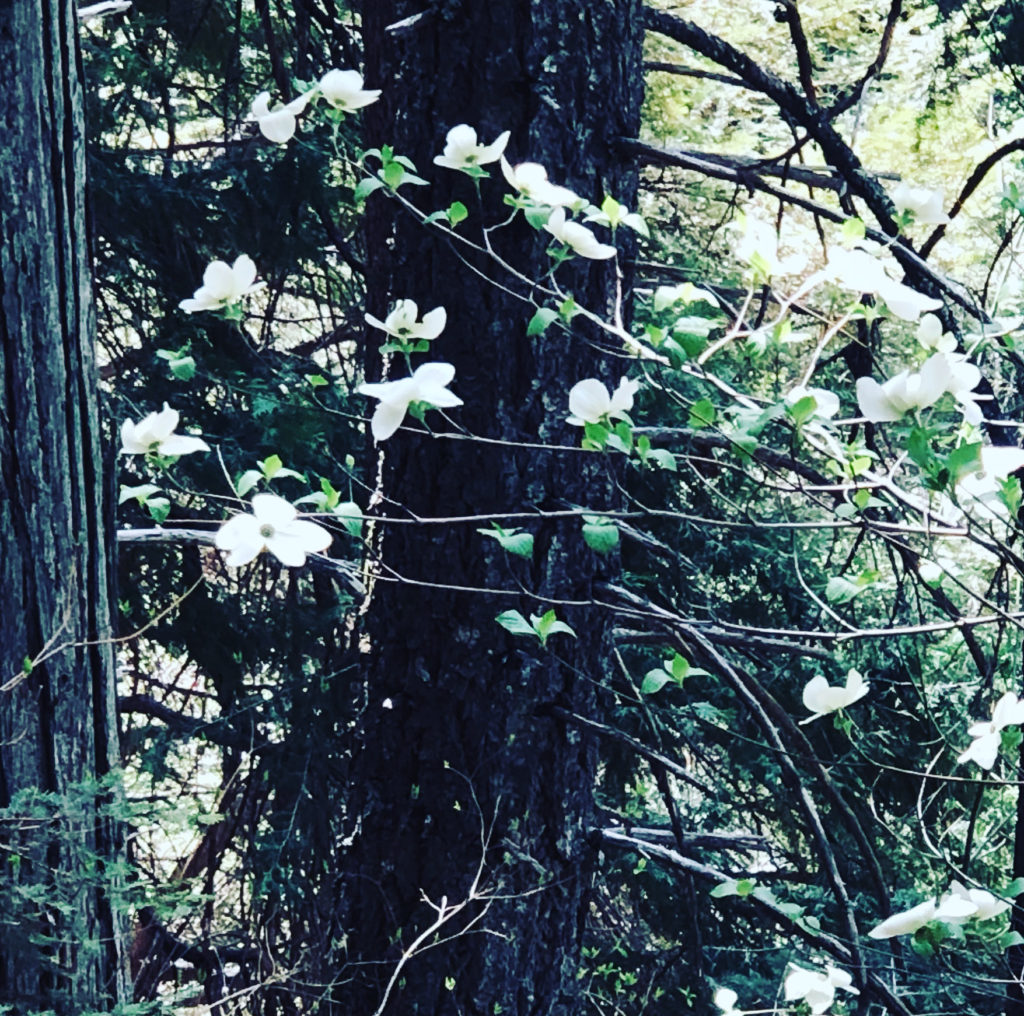
The Pacific Dogwoods are going off right now. They are a beautiful reminder that Summer is coming. Get to the mountains this weekend and check them out.
From the US Forest Service:
‘Pacific dogwood is in the Cornaceae (dogwood Family) which contains approximately 12 genera and 100 species distributed primarily through temperate and tropical mountainous regions. Indigenous people used the bark of Pacific dogwood to make a brown dye and a decoction for stomach trouble. Young shoots were often used for weaving baskets. The wood of this species is hard and heavy and has been used commercially to make a wide variety of products including bows, arrows, thread spindles, cabinets, piano keys, mallet handles, and golf club heads. In medieval times, the hard wood of dogwood species was used for making wooden daggers. The brilliant fall colors of the leaves make Pacific dogwood a valuable ornamental. As with its close relative, flowering dogwood, it is susceptible to dogwood anthracnose, a disease caused by the nonnative fungus Discula destructiva. The disease is responsible for the death of some larger trees in the wild and the disease has restricted its Pacific dogwood’s use as an ornamental.
Pacific dogwood is a deciduous tree growing up to 20 meters tall (66 feet) with a smooth dark bark. Leaves are oval, pointed at the tip, 4-10 cm (1.6-3.9 inches) long, deep green in color, and have parallel veins. Flowers occur in tight clusters 1.5-2 cm (0.6-0.8 inches) wide and are subtended by 4-8 conspicuous white bracts 2-7 cm (0.8-2.8 inches) long. Petals are greenish white and often tinged purple. Trees will flower in the spring and often again in the fall. Fruits are bright red and approximately 10 mm (0.4 inches) long.
Distribution is restricted to the Pacific Northwest and California extending from southern British Columbia south through Washington, Idaho and Oregon to California primarily west of the Cascades and Sierra Nevada. It has a relatively low tolerance to frost, a relatively high tolerance to flooding and is moderately shade tolerant. It is common along stream banks in low elevation coniferous, hardwood, and mixed coastal forests. It prefers moist but well drained soils on gentle slopes predominantly below 1500 meters (5000 feet) elevation. It is capable of sprouting from root crowns after fire.
Deer and elk browse young Pacific dogwood sprouts for forage. Small mammals such as deer mice and the red tree vole and birds, including band-tailed pigeons and pileated woodpeckers feed on the fruits.
Cornus nuttallii was named after Thomas Nuttall, an English botanist and zoologist who worked in the United States during the 1800s’

Sadly, Jon Baiocchi passed away April 22, 2021 while he was doing what he loved, guiding on the Middle Fork of the Feather River.
I met Jon years ago at the annual Fly Fishing show in Pleasanton. I had a couple of questions and when he was answering them, he gave his full attention to giving me the right information. I was really impressed with his generosity, focus, and dedication to protecting our natural resources. After that meeting, I started paying much more attention to his blog, articles, and interviews.
Jon had a unique view of his role as a guide. He openly shared information with anyone that was looking for help. Most guides that I’ve met will give people little nuggets of information but hold back on giving anything significant to non-clients. Jon must have realized the value in being a trusted authority very early on.
He was also focused primarily on walk-n-wade guiding. This is unusual in California- I heard one guide say that he thought this was a crazy business model- show the client what they need and they won’t need to hire you again. Jon certainly took the long view. He certainly wasn’t immune to boats- he was the grand master guide of Lake Davis.
Jon is responsible for my entry into guiding. I love walk-n-wade fishing on lightly pressured water and I love to teach people. Jon illustrated how those passions be coexist with guiding. He kindly offered to help me with the national forest service permit process. He was given the same offer from Frank Pisciotta, the famed Truckee guide back when he was starting out. Frank and Jon’s father (Bob) were clearly significant forces in Jon’s life. Ironically, Frank passed away last year.
Jon’s legacy will live on in the actions of those that he taught and inspired. He will be missed by many in the NorCal fly fishing community.
RIP Jonny B
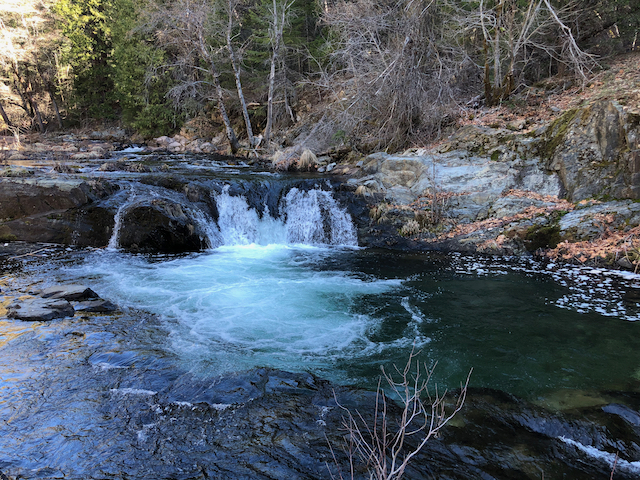
The North Fork of the Yuba river is an amazing river. It hold loads of wild Rainbow Trout as well as some Brown Trout.
Some of the tributary rivers include : Lavezzola Creek, The Downie River, Pauley Creek, Butcher Creek, Haypress Creek, Milton Creek, and Salmon Creek. These creeks are full of small and hungry wild trout.
Fishing these small streams is generally best done with a light and short fly rod with a short leader…something like a 8 foot 3 weight rod with a 7 1/2 foot leader on a floating line. The name of the game is to keep moving- cast a few times and move to the next pool.

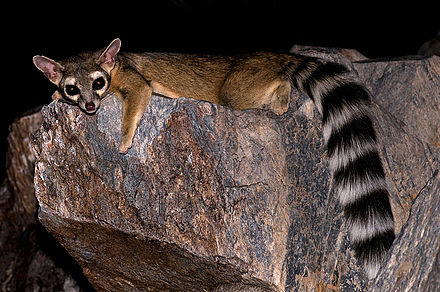
We had a Ring-Tailed Cat come by. They are rarely seen but are widely distributed. It’s probably the cutest wild animal that we’ve come across.
From Wiki:
The ringtail is black to dark brown in color with pale underparts. Ringtails have a pointed muzzle with long whiskers resembles that of a fox (its Latin name means ‘clever little fox’) and its body that resembles that of a cat. The ringtailed’s face resembles a mask as dark brown and black hair surround its eyes.[2] These animals are characterized by a long black and white “ringed” tail with 14–16 stripes,[3] which is the about the same length as its body. The claws are short, straight, and semi-retractable, well-suited for climbing.[4]
Smaller than a house cat, it is one of the smallest extant procyonids (only the smallest in the olingo species group average smaller). Its body alone measures 30–42 cm (12–17 in) and its tail averages 31–44 cm (12–17 in) from its base. It typically weighs around 0.7 to 1.5 kg (1.5 to 3.3 lb).[5] Its dental formula is 3.1.4.23.1.4.2 = 40.[6]
Ringtails are primarily nocturnal, with large eyes and upright ears that make it easier for them to navigate and forage in the dark. An adept climber, it uses its long tail for balance. The rings on its tail can also act as a distraction for predators. The white rings act as a target, so when the tail rather than the body is caught, the ringtail has a greater chance of escaping.[7]
Ringtails have occasionally been hunted for their pelts, but the fur is not especially valuable. Fur trapping has slowed down considerably, but current population sizes and growth rates remain unclear.[8]

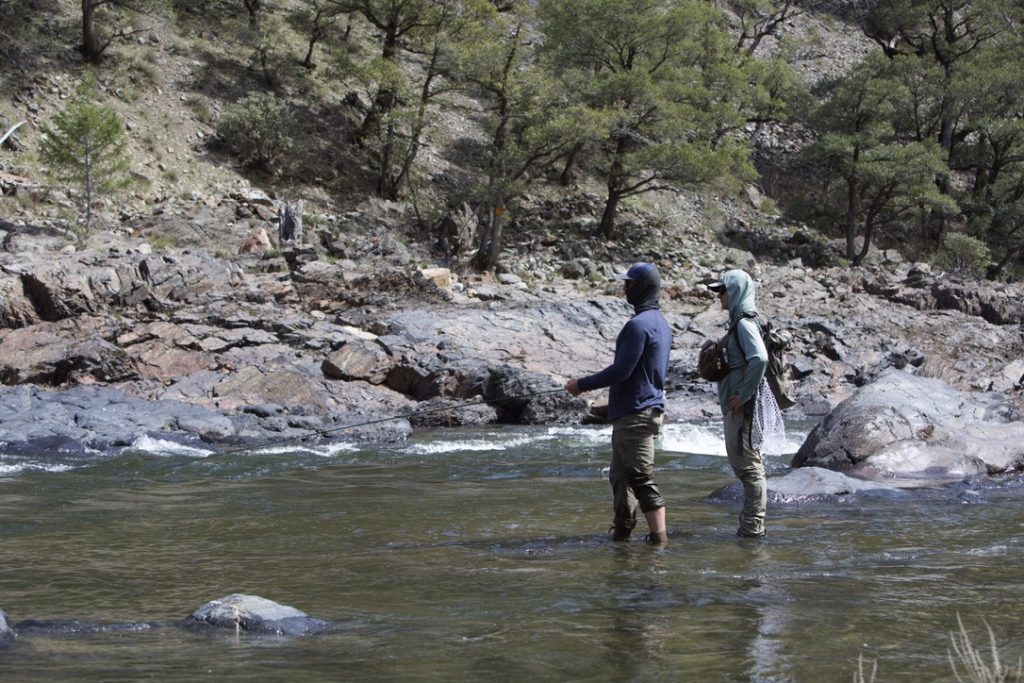
With the light snowpack, it’s going to be an early season. Start planning now for your Sierra adventures. The inns and hotels will be getting booked up.
The flows are up, but they will be coming down sooner than usual. When the flows hit 400 cubic feet per second or less, the fishing is ON. I keep an eye on the USGS guage below Goodyears Bar, here is a link.

This film was funded by Patagonia. They make great products and support environmental causes. The film highlights the efforts of the Sierra Buttes Stewardship to build and maintain the local trail system. These connected trails connect people to this beautiful place and the small communities that are dotted throughout.

From Eileen at Mountain Valley Living:
High in the mountains of the Northern Sierra snow melt and natural springs gravitate together and begin their journey down a magnificent watershed, and The North Fork Yuba River is born. Surrounded by a coniferous forest and polished granite boulders that have been worn to a glimmering shine this river is also home to native wild rainbow trout that sparkle like jewels in the mountain sunshine. There is also nonnative Brown trout here that are the offspring from their parents who made the journey up the river from Bullards Bar reservoir in search of the perfect spawning grounds. The North Yuba also attracts anglers from all over the state who make their own journey to ply the waters whether it is by fly or lure. Here is a place than can offer unbound beauty, adventure, solitude, and a chance to hook into a trophy trout!
As you make your up Highway 49 from Nevada City there are numerous major access points along the way upstream after the first bridge crossing near the Canyon Creek trailhead. Other obscure access areas are mere pullouts with steep descents down to the river and only for the most adventurous souls. What sets this river apart from the many grand waters of Northern California is the type of water preferred by fly anglers; pocket water, pools and gin clear water.
The North Yuba is open year all year for fishing but with special regulations. There is a “wild trout” section from Sierra City to Ladies Canyon Creek and only barbless flies and artificial lures may be used with a two fish limit if one decides to keep their catch. Most fly anglers practice “catch and release” fishing so that the populations of wild trout may grow bigger and provide others with the enjoyment of catching the big one. The California Department of Fish and Wildlife’s regulation booklet provides all the information a visiting angler needs to be legal here and should be reviewed before venturing out onto the water.
Winter and spring conditions are rather tough for successful fishing, low water temperatures and high water makes it difficult for even expert anglers. The most productive fishing takes place after spring runoff has ended which normally takes place sometime in June. As summer engulfs the North Yuba so do the aquatic insects that the wild trout eagerly dine on. Hatches of mayflies, caddis, and stoneflies fill the air and offer exciting “dry fly” fishing, presenting flies that float on the surface of the water enticing a trout to rise to the occasion and devour the artificial offering. Great fishing continues through even the hottest dog days of summer as the upper river still provides cold water. Fall is a special time on the North Yuba, leaves glow showing their spectacular colors and the trout feed more aggressively knowing they have to fatten up for the long cold winter months ahead of them. There is also a special aquatic insect that hatches this time of year and even has a cult following amongst fly anglers. The October Caddis is a large specimen with a burnt orange color that brings up some of the largest trout for a floating prime rib dinner drifting down the currents.
There are no special tackle requirements to fish the North Yuba, a 3-5 weight rod matched with a floating line and leaders to 4-6x will perform nicely. Sierra Hardware in Downieville is the only place in the area you can find terminal tackle and a large assortment of the “go to” flies that work best on the river. There is also a current fishing report posted in the store which will help visitors eliminate the guess work and get straight to business when picking out the right fly to use.
The North Fork Yuba is a fascinating river with a surprise around every corner. I really love this place; it reminds me of learning to fly fish on the North Fork Feather River when I was a boy. It’s a rough and tumble kind of a river with a fast pace, and the roar of the white water echoes off the canyon walls. Where Robins stuff their bellies full of stoneflies, and take retreat on a low branch of a pine next to the river. They eat their meal, gaze about, and take in the sights and sounds of this most impressive watershed.
Haypress Creek joins the North Yuba just above Sierra City. Haypress offers small rainbows and, in its upper stretches, small brook trout. Above Sierra City on hwy 49 take Wild Plum Road to access Haypress and a nice section of the North Yuba. There are lots of small trout in Haypress. There may be planted fish at the campground but wild fish can be found upstream via Haypress Creek Trail. The trailhead is located on the north side of the bridge at Wild Plum Campground.